Bulk ATAC-seq analysis of Mature and Memory human NK cells


This repository is a curated, public-facing snapshot of a three-week educational bulk ATAC-seq project. It documents a donor-aware comparison of chromatin accessibility between Mature and Memory human natural killer (NK) cells using public sequencing accessions from Calderon et al. (2019).
Project context
This work was completed during the three-week full-time internship component of the M.CoBi.310 Systems Biology course at the University of Göttingen, in collaboration with the University Medical Center Göttingen (UMG).
This repository is an independent, student-authored public release for educational and portfolio use. It is not an official University of Göttingen or UMG software product, publication, or institutional endorsement.
Primary result: 59,186 consensus regions passed the prespecified low-count filter. No region met the declared differential-accessibility threshold of adjusted p-value < 0.05 and absolute log2 fold change >= 1, using either ordinary or apeglm-shrunken effect estimates.
Nominal raw-p-value candidates, nearest-gene annotations, enrichment results, motif results, and IGV views are retained only as exploratory hypothesis- generation material. They are not FDR-significant discoveries and do not establish transcription-factor activity, regulatory targeting, or mechanism.
Start here
- Browse the project as a searchable website: open the documentation site for sidebar navigation, search, and copy buttons on command blocks.
- Reproduce or inspect this internship case study: read the
reproducibility notes and the stage-specific
documentation in the
workflow/guide. - Apply the same general approach to a new experiment: follow the step-by-step bulk ATAC-seq tutorial, beginning with the beginner-friendly installation and setup guide and quick-start checklist.
- Try a fast known-output example: run the dependency-free synthetic count-matrix smoke test before using real data.
- Work with an AI agent: begin with the
human-supervised agent interface. It provides a staged
workflow contract, machine-readable configuration and status files,
deterministic validation, and a repo-scoped Codex skill named
$bulk-atacseq-agent.
The tutorial covers conventional bulk, paired-end ATAC-seq. It is not a single-cell ATAC-seq workflow, and its example commands must be adapted to the organism, reference build, library design, sample structure, and computing environment of each study.
Skills demonstrated
| Area | Methods and tools |
|---|---|
| Experimental design | Paired donors, replicate structure, covariate-aware modeling, prespecified contrasts |
| Bulk ATAC-seq | FastQC, Cutadapt, Bowtie2, SAMtools, Picard, MACS3, featureCounts |
| Statistical analysis | R, DESeq2, apeglm shrinkage, multiple-testing control, sensitivity analysis |
| Exploratory interpretation | GENCODE annotation, g:Profiler, HOMER, IGV, cautious non-causal reporting |
| Reproducibility | Bash, Python, validation tests, checksums, provenance records, non-overwriting outputs |
| AI-assisted analysis | Human-approval gates, machine-readable schemas, durable status, deterministic validation |
Study design
| Item | Value |
|---|---|
| Assay | Bulk ATAC-seq |
| Comparison | Memory NK relative to Mature NK |
| Samples | 10 public SRA runs |
| Donors | 6 |
| Cell-type composition | 4 Mature NK; 6 Memory NK |
| Complete donor pairs | 4 |
| Memory-only donors | 2 |
| Consensus regions | 112,759 |
| Primary filter | Count >= 10 in at least 5 of 10 samples |
| Regions tested | 59,186 |
| Statistical design | ~ donor + cell_type |
| Primary threshold | adjusted p < 0.05 and absolute LFC >= 1 |
| Significant DARs | 0 |
The Week 1 sample, SRR7650763, is an untreated Immature NK sample analyzed on a chromosome-22 teaching subset. It is separate from the ten-sample Mature versus Memory comparison.
Workflow
- Week 1 training: read QC, trimming, alignment, pair-preserving filtering, duplicate removal, blacklist removal, peak calling, and focused QC on the chromosome-22 teaching subset.
- Consensus and counting: condition-level peak unions were merged into a 112,759-region universe; featureCounts quantified paired fragments.
- Differential accessibility: DESeq2 fitted a donor-aware model after the fixed 10-in-5 low-count filter; apeglm provided shrunken effect estimates.
- Exploratory follow-up: filter sensitivity, GENCODE annotation, g:Profiler, HOMER, and six-locus IGV review.
The scripts in workflow/ are public-release adaptations of the preserved
validated project scripts. Their relationship to the executed analysis is
documented in Reproducibility.
Selected results
Sample-level exploratory QC
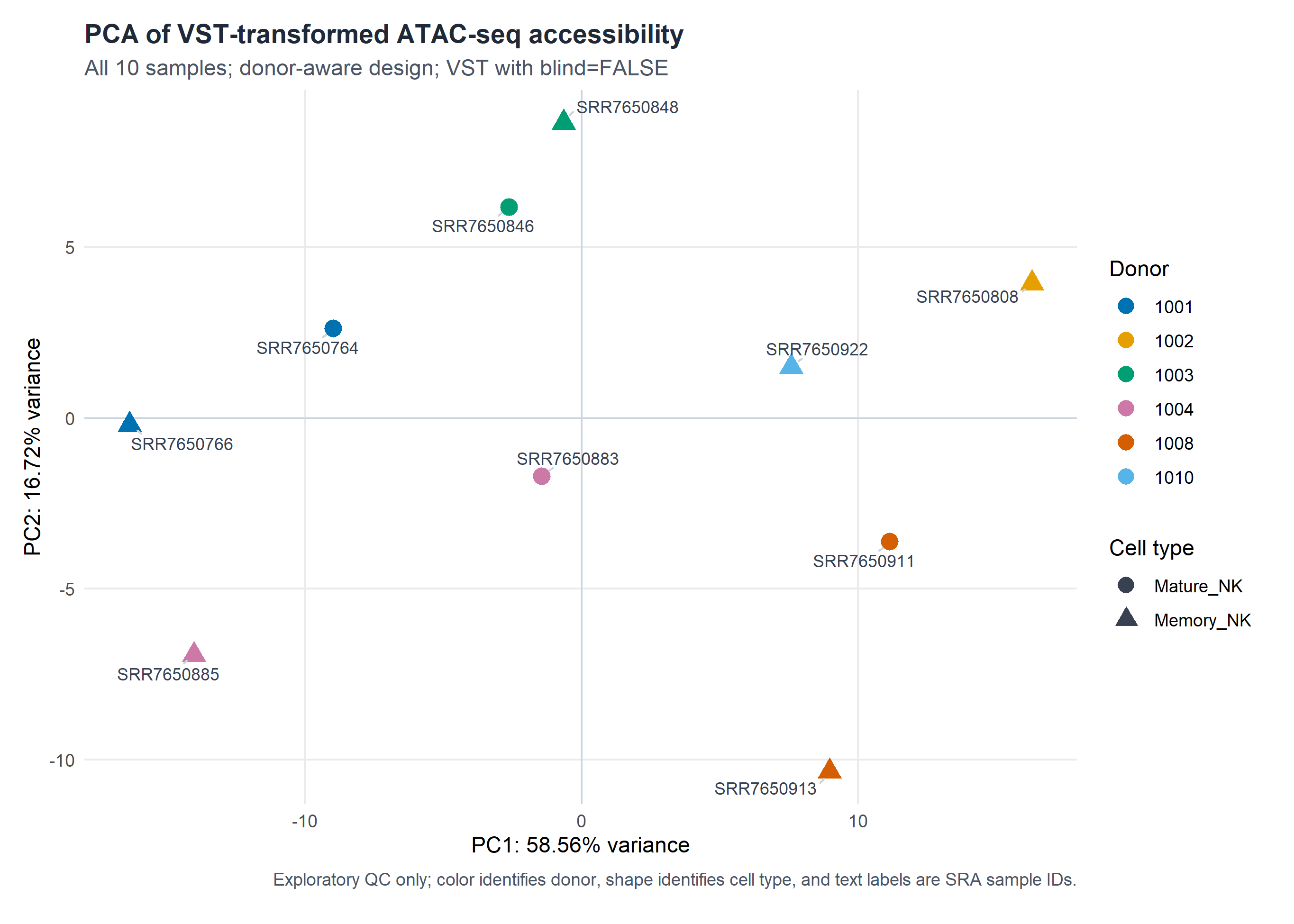
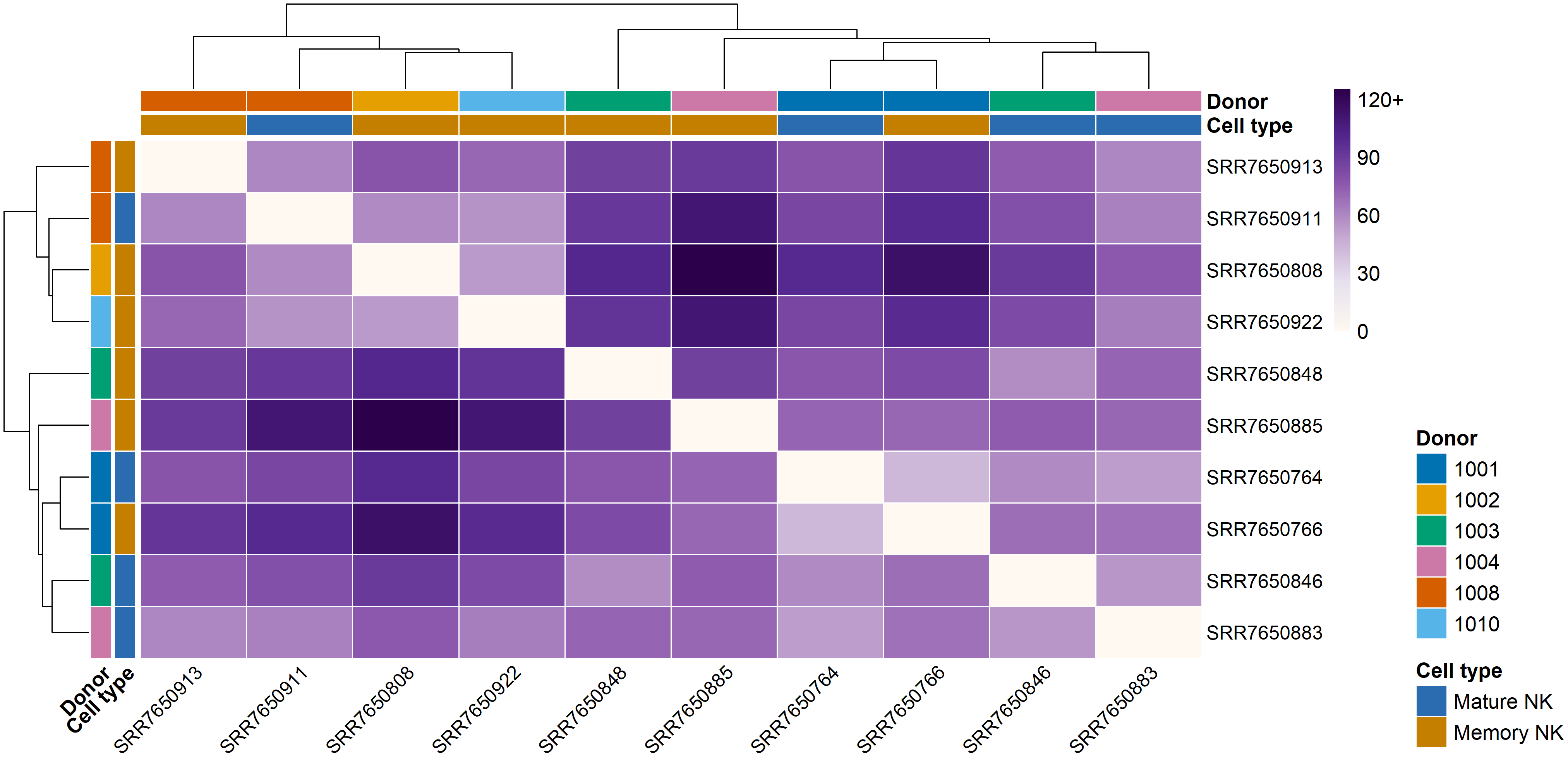
The PCA and heatmap are descriptive sample-level QC. They are not tests of differential accessibility.
Primary differential-accessibility result
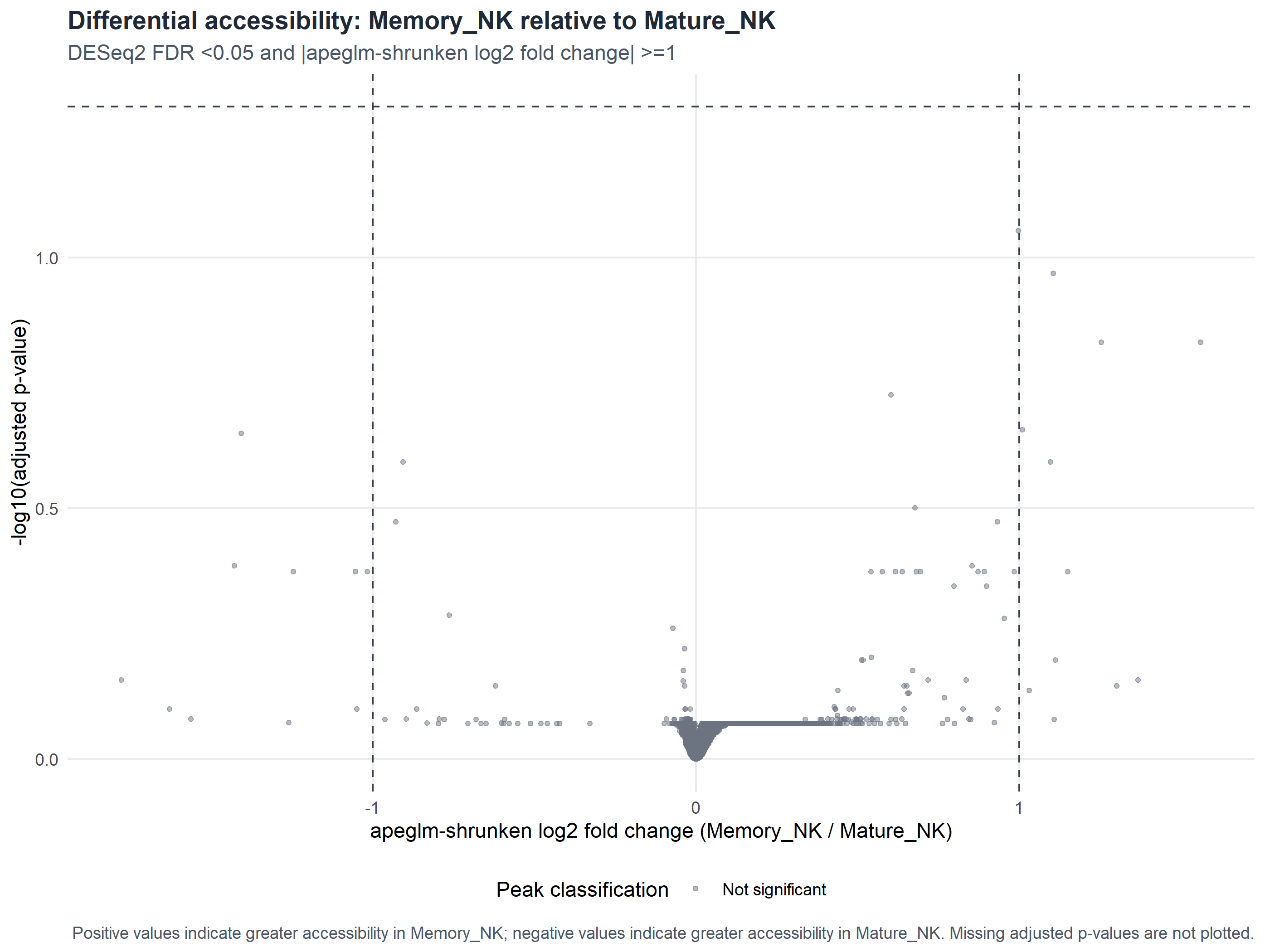
No point met the joint adjusted-p-value and absolute-LFC threshold. The absence of significant DARs does not mean that peak calling failed or that every sample had identical accessibility.
Nominal sensitivity analysis
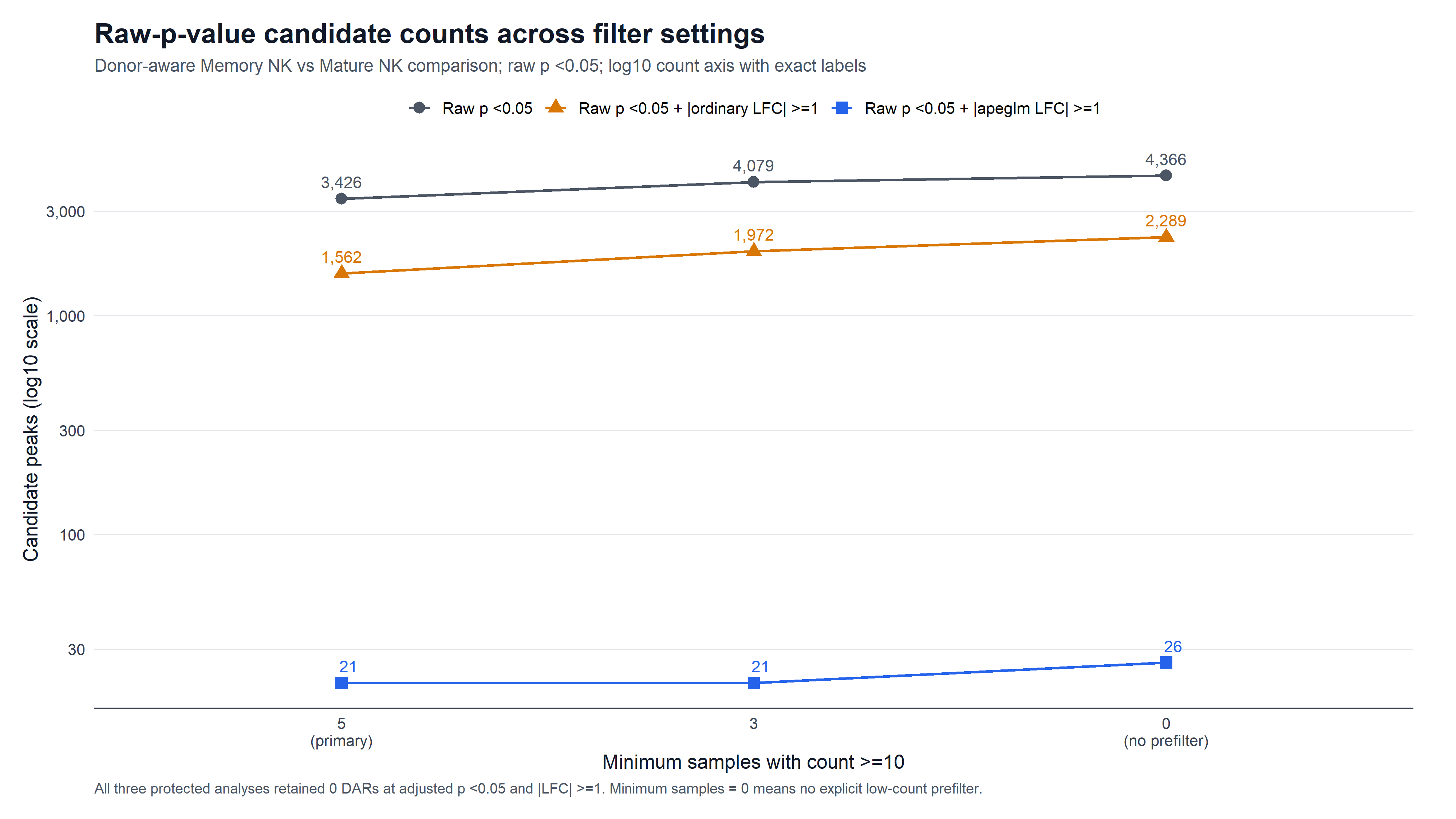
These bars summarize raw-p-value candidate definitions. They do not count FDR-significant DARs; there were none in any tested filter scenario.
Exploratory annotation
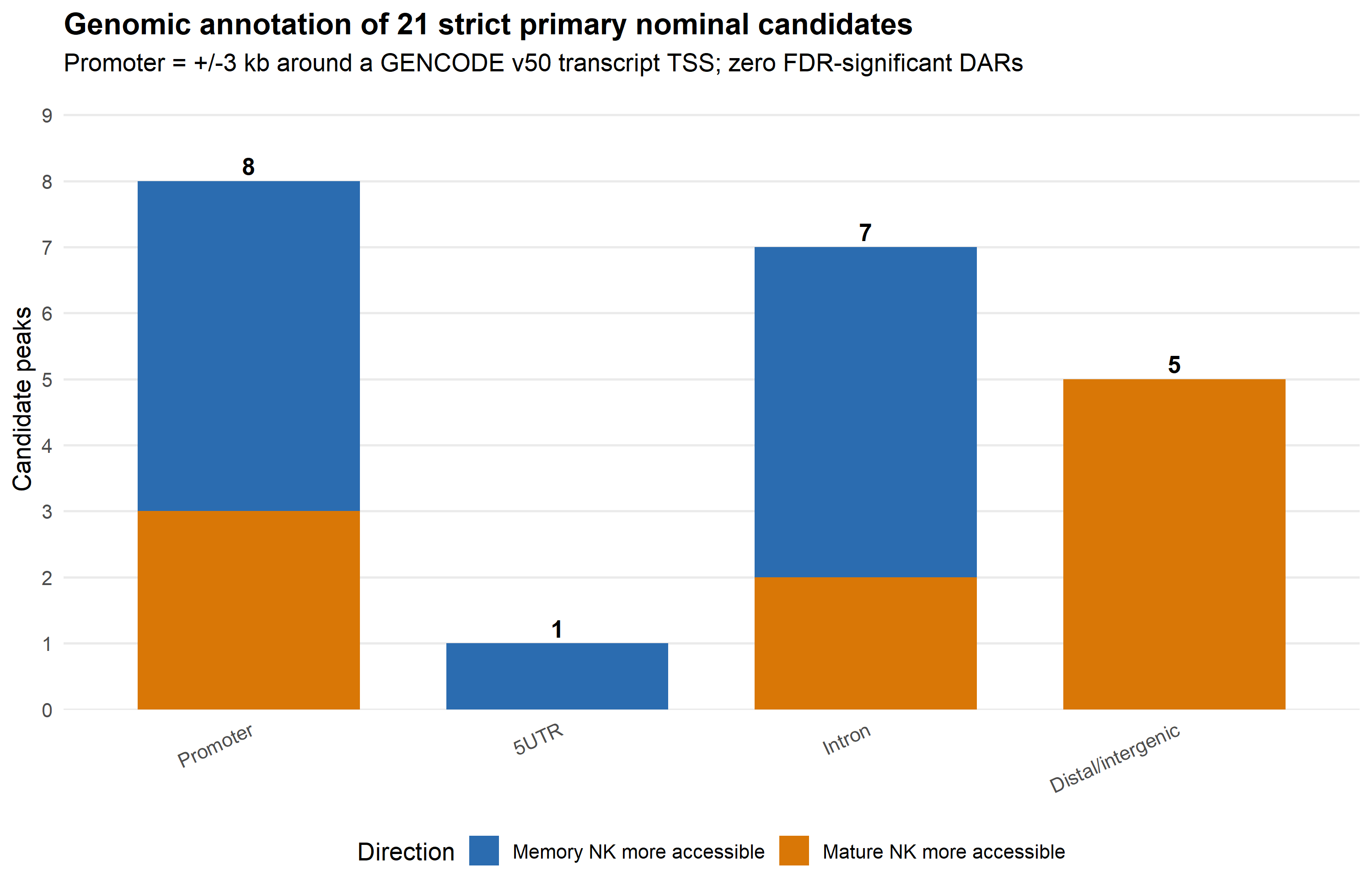
The 21-region strict nominal set contained 8 promoter, 1 5' UTR, 7 intronic, and 5 distal/intergenic regions. Nearest-gene assignments are hypotheses, not validated regulatory links.
Repository contents
config/       public sample registry and analysis parameters
workflow/     public-release workflow scripts grouped by analysis stage
results/      small summary tables and selected report-ready figures
docs/         project documentation and reusable step-by-step tutorial
agent/        provider-neutral AI-agent contract, schemas, state, and examples
environment/  recorded software and package versions
demo/         synthetic inputs, expected outputs, and a fast smoke test
Raw reads, BAM/BAI files, reference genomes, indexes, large peak collections, full count matrices, full DESeq2 tables, signal tracks, caches, build products, and course materials are deliberately excluded.
Data availability
The repository does not redistribute sequencing data. Public SRA accessions and
the required derived-input roles are listed in
DATA_AVAILABILITY.md and
config/samples_public.tsv.
Reuse and citation
This is a post-internship release snapshot, not the original execution history.
The initial Git commit should therefore not be interpreted as the date on which
the analyses were performed. Citation metadata are supplied in CITATION.cff.
Version history is recorded in CHANGELOG.md.
The curated repository is released under the MIT License. Third-party data,
software, databases, and excluded educational materials retain their own terms.
See LICENSE and THIRD_PARTY_NOTICES.md.
Author
Yazan Aljerro, 2026
Key reference
Calderon D, et al. Landscape of stimulation-responsive chromatin across diverse human immune cells. Nature Genetics. 2019;51:1494-1505. https://doi.org/10.1038/s41588-019-0505-9